Learning by Doing: How VIS Students Are Building Professional Skills Early
Jul 07, 2026
Most students get their first professional experience after graduation — a summer internship squeezed between their second and third year of college. At Venkateshwar International School (VIS), Dwarka Sector 10, that timeline has been moved up by nearly a decade.
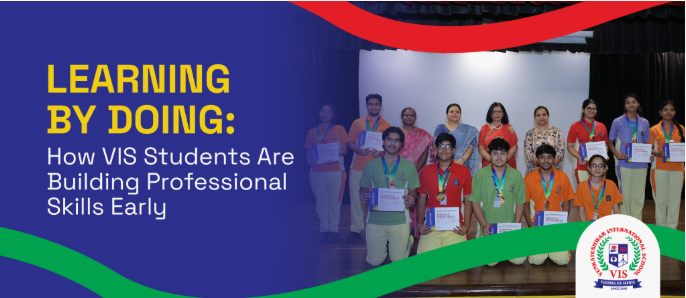
In 2026–27, 212 students across Class IX - XII at VIS completed structured internships across 27 industry and programme partners — real hospitals, chartered accountancy firms, investment companies, research institutions, NGOs, wellness organisations, publishing houses, and vocational setups. Not as observers. As participants with responsibilities, deadlines, and professional expectations.
This is what the VIS Student Internship Programme looks like at full scale — and why it is one of the most ambitious experiential learning initiatives running in any school in Dwarka today.
What Is the VIS Student Internship Programme?
The VIS Student Internship Programme places students from Class IX through Class XII in real professional environments aligned to their stream, interests, and stage of development. It is not a field trip. There are no worksheets to fill in on a bus ride back. Students work alongside professionals — learning what their chosen field actually looks like from the inside.
What makes the VIS model distinctive is the breadth of the cohort. This is not a programme for senior students alone. Class IX and X students participate in their own structured cohort, with placements calibrated to their developmental stage — building foundational professional habits, exploring career directions, and developing skills that compound steadily through Class XI and XII.
By the time a VIS student reaches Class XI, they have already worked in a professional environment. That head start is not incidental. It is by design.
By the Numbers — VIS Internship Programme 2026–27
| Metric |
Figure |
| Total students across all classes |
212 |
| Class IX & X participants |
80 |
| Class XI & XII participants |
132 |
| Total industry and programme partners |
27 |
| Sectors covered |
9 |
| Largest single programme |
Financial Awareness — 37 students combined (IX-X + XI-XII) |
| Second largest programme |
Scope for Change — 47 students (XI-XII) |
| Hospital partners |
4 (Fortis network + Marengo Asia) |
| Research partners |
1 (IIT Madras Pravartak) |
| CA and finance partners |
5 |
212 students placed across 29 partners in a single academic year is not a pilot or an experiment. It is institutional infrastructure — a programme built into the school's calendar, not bolted onto it.
Two Cohorts, One Philosophy
The 2026–27 internship programme runs across two cohorts with distinct but connected objectives.
| |
Class IX & X Cohort |
Class XI & XII Cohort |
| Students |
80 |
132 |
| Partners |
15 |
14 |
| Focus |
Career exploration, foundational professional skills |
Stream-aligned professional exposure, career validation |
| Key sectors |
Technology, financial literacy, wellness, research, social impact, vocational |
Healthcare, finance, social impact, psychology, publishing |
| Programme character |
Broad, exploratory, cross-domain |
Focused, stream-specific, outcome-linked |
The IX–X cohort builds the foundation. The XI–XII cohort builds on it.
Class IX and X — Where Junior Students Interned
Technology and Digital Skills — Cybernex
Students: 12 | Class: IX and X
Cybernex placed Class IX and X students in a technology and digital skills environment — working with software tools, digital workflows, and basic tech applications. For students at 14 and 15, this is not about becoming programmers. It is about demystifying technology as a professional environment and building the digital confidence that every career path now requires.
Financial Literacy — Financial Awareness Programme
Students: 22 | Class: IX and X
The largest single programme in the junior cohort. Twenty-two Class IX and X students participated in a structured financial awareness track — learning about personal finance, budgeting, investment basics, and how financial systems work at a practical level.
Financial literacy is not part of the standard school curriculum. A Class IX student who understands compound interest, basic taxation, and how a bank balance sheet works is already ahead of most adults. This programme builds that foundation early.
Research and Innovation — IIT Madras Pravartak
Students: 8 | Class: IX and X
This is one of the most distinctive placements in the entire 2026–27 programme. Eight Class IX and X students were placed with IIT Madras Pravartak — an innovation and research initiative linked to one of India's premier technical institutions.
For a school student to engage with IIT Madras's research ecosystem at 14 or 15 — working on structured problem-solving, experimental thinking, and innovation frameworks — is an exceptional level of exposure. For students considering engineering, research, or technology careers, this is the kind of early signal that shapes the next decade of academic choices.
Wellness and Personal Development — Stand & Stride, Sthir, YWP
Students: 18 | Partners: Stand & Stride (5), Sthir (10), YWP (3)
Three wellness and personal development programmes combined to place 18 junior students in environments focused on mental resilience, physical wellbeing, youth leadership, and emotional intelligence.
- Sthir (10 students) — mindfulness, focus, and stress management frameworks
- Stand & Stride (5 students) — communication, confidence, and public presence training
- YWP (3 students) — youth workforce preparedness and leadership development
For Class IX and X students navigating the transition from middle to senior school — and the academic pressure that comes with it — these placements are not peripheral. They are directly relevant to the next three years.
Media, Publishing and Film — Mithaas Book Publishing, Stoic Films
Students: 5 | Partners: Mithaas Book Publishing (4), Stoic Films (1)
Junior students placed with Mithaas Book Publishing worked on editorial and production processes — from manuscript handling to publishing workflows. The student placed with Stoic Films experienced film production environments, scripting, and content creation at a professional level.
For students with an instinct toward writing, storytelling, media, or the arts, these placements provide early confirmation that these are real, structured career paths — not hobbies to set aside for "more serious" options.
Social Impact — CRY, Goonj, Skill India, PETA India, Daayitva
Students: 6 | Partners: CRY, Goonj, Skill India, PETA India, Daayitva
Junior students placed across India's established civil society organisations — CRY (Child Rights and You), Goonj (humanitarian aid), Skill India, and PETA India — worked on outreach, documentation, and programme support. Two students also participated in VIS's own Daayitva social responsibility programme as a structured professional track.
Engaging with organisations like CRY and Goonj at 14 is a values formation experience as much as a professional one. Students working at this level understand what civil society looks like — not as an abstract concept in a Political Science chapter, but as an operational reality with measurable impact.
Vocational and Emerging Careers — Go Sharpner, Airborne Aviation, Tourism Company, Electrical Shop
Students: 7 | Partners: Go Sharpner (4), Airborne Aviation (1), Tourism Company (1), Electrical Shop internship (1)
The most diverse cluster in the junior cohort. Four students at Go Sharpner developed career readiness and vocational skills. One student interned at an aviation company — an early exposure to an industry that has limited entry points for school students. One gained hands-on experience at a tourism and hospitality company. One completed an internship at an electrical shop — practical, skill-based learning that the classroom cannot provide.
The breadth here is intentional. Not every student is heading to IIT or IIM. VIS's programme acknowledges that vocational skills, trade knowledge, and emerging career paths are equally legitimate — and equally worth exploring at 14.
Class XI and XII — Where Senior Students Interned
Healthcare — Hospitals and Clinical Exposure
Partners: Fortis Hospital (Vasant Kunj), Fortis Hospital (Shalimar Bagh), Fortis Hospital (Gurugram), Marengo Asia Hospital (Gurugram) | Students: 40
Science (PCB) students placed across the Fortis network and Marengo Asia Hospital experienced clinical observation, patient interaction protocols, departmental workflows, and the day-to-day culture of a working healthcare institution.
The difference between reading about hospital systems in Class 12 Biology and standing inside one — watching how decisions are made, how teams communicate under pressure, how care is actually delivered — is not incremental. It is fundamental. Students who have had that exposure arrive at NEET preparation with a clarity and motivation that classroom-only students often take years to develop.
Finance and Accounting — CA Firms and Investment Partners
Partners: MoneyTree Partners, Ravi Arora & Co., Arjun Gupta & Associates, CA Sethi Agarwal & Associates, Financial Awareness by CASEL | Students: 31
Commerce stream students were placed across four CA and finance firms plus a structured financial literacy track. At CA firms, students observed audit processes, client documentation, tax filings, and accounting operations — the exact environment they are working toward if they pursue CA Foundation after Class 12.
At MoneyTree Partners, students engaged with investment thinking, portfolio concepts, and financial advisory client work — opening the door to careers in wealth management, banking, and financial services beyond pure accountancy.
Social Impact — Scope for Change
Partner: Scope for Change | Students: 47
The single largest placement in the senior cohort, Scope for Change drew students from across all three streams — Science, Commerce, and Humanities. Students worked on community outreach, project coordination, stakeholder communication, and grassroots programme delivery: skills that are genuinely cross-functional and valued in every professional environment.
Psychology and Mental Health
Partners: Nestling Minds, Unique Psychological Services | Students: 5
Humanities students taking Psychology as an elective gained structured observation and support experience in active counselling and mental health environments — observing client intake, support group facilitation, and therapeutic frameworks in practice. For students considering BA or BSc Psychology, this is exposure that peers at most other schools will not get until their second year of undergraduate study.
Publishing, Media and Technology
Partners: Mithaas Publications (CASEL), Cybernex (CASEL) | Students: 5
Students in the publishing and technology tracks worked on editorial workflows, content creation, digital tools, and publishing operations — practical experience for students considering careers in media, communications, content, and tech outside the engineering route.
What Professional Skills Did Students Build?
Across all nine sectors and both cohorts, the skills students developed fall into two categories: domain-specific and transferable.
Domain-specific skills by sector:
- Clinical observation and medical protocols (healthcare)
- Accounting workflows, audit support, financial documentation (finance)
- Community project design and stakeholder communication (social impact)
- Research methodology and innovation frameworks (IIT Madras Pravartak)
- Editorial and publishing production processes (media and publishing)
- Counselling support and mental health documentation (psychology)
- Digital tools and technology workflows (Cybernex)
- Mindfulness, leadership, and communication frameworks (wellness)
- Trade skills and vocational awareness (vocational placements)
Transferable skills built across all cohorts and sectors:
- Professional communication — written, verbal, and workplace etiquette
- Time management within structured, accountable work schedules
- Teamwork with professionals outside a school peer group
- Problem-solving under real constraints, not hypothetical scenarios
- Empathy and active listening (especially healthcare and psychology)
- Self-presentation and accountability in non-academic environments
- Report writing and professional documentation
- Initiative-taking when tasks are not predefined in instructions
- Financial awareness and economic thinking (finance literacy track)
- Digital confidence across tools and platforms
No worksheet or classroom simulation builds these the same way. The gap between understanding professional behaviour and actually demonstrating it in a real environment closes only through practice.
Why Starting in Class IX Makes a Difference
The VIS model does not wait for Class XI to introduce students to professional environments. The junior cohort begins at Class IX — and there are strong reasons why that early start compounds over time.
- Habit formation, not just skill development. Professional habits — punctuality, accountability, communication norms, managing a workday — are most effectively formed when they are learned early and reinforced repeatedly. A student who first experiences a professional environment at 14 has two more years to refine those habits before the Class XI and XII period begins.
- Career curiosity without pressure. At Class XI, stream selection has already happened. Exploration is constrained. At Class IX, students can engage with finance, technology, wellness, research, and social impact without the pressure of that choice. The junior cohort is explicitly designed to be broad and exploratory — giving students information about what different careers actually feel like before they have to make a decision.
- Stream selection with evidence. The students who complete junior internships in Class IX and X arrive at the Class X-to-XI transition with something most of their peers lack: real experience in a domain. A student who has worked in a financial literacy programme for a month in Class IX is making a much better-informed decision when they choose Commerce in Class XI.
- Building on each year. The programme is designed as a ladder, not a one-time event. Class IX exploration → Class X consolidation → Class XI stream-aligned exposure → Class XII career-direction confirmation. Each year builds on the last.
Why Internships — Not After Graduation?
The standard model puts professional experience after the degree. VIS has inverted that logic — and there are clear reasons why the early model produces better outcomes.
- Stream validation. The cost of discovering that medicine isn't for you after four years of MBBS is very high. A Class XI student who spends two weeks in a hospital knows something real about what a medical career involves before committing to NEET preparation.
- College readiness. For students applying to selective domestic programmes or universities abroad, meaningful professional experience is expected, not optional. A student who can describe a real internship — naming what they observed and what it taught them — is a fundamentally stronger applicant.
- Confidence that transfers. Classroom confidence and professional confidence are different skills. Students who develop the latter in Class IX or XI arrive at college with a composure that peers notice and that interviewers remember.
The CASEL Partnership — Structured Learning Within the Programme
Three tracks in the 2026–27 programme operate under the CASEL framework — Financial Awareness, Mithaas Publications, and Cybernex — spanning both the junior and senior students. CASEL brings curriculum structure to internship experience: defined learning outcomes, organised activities, and a pedagogical approach that turns work experience into deliberate skill development.
This distinction matters. An ad hoc placement at a family contact's office can produce exposure. It rarely produces structured learning. CASEL-partnered tracks ensure students are not just observing — they are progressing through a designed learning arc with clear takeaways at each stage.
How This Connects to VIS's Larger Education Philosophy
The internship programme is not a standalone initiative. It is the most operational expression of the philosophy VIS has built across 25 years in Dwarka Sector 10.
- Personalised learning — stream-aligned placements at XI-XII level, interest-driven placements at IX-X level. Not one programme for 210 students regardless of direction, but 27 distinct placements matched to individual trajectories.
- Holistic development — professional experience alongside academics, sports, arts, and values education. All of it part of the same picture.
- Daayitva — VIS's social responsibility programme finds real-world expression in the Scope for Change cohort (47 students, XI-XII) and the CRY, Goonj, Skill India, and PETA placements at IX-X level.
- Future-readiness — the same school that has introduced AI into the Class IX-XII curriculum, runs an Atal Tinkering Lab, and holds CBSE Skill Hub certification is also placing Class IX students with IIT Madras Pravartak. That coherence is not accidental.
Frequently Asked Questions
Q1. What is the VIS student internship programme?
The VIS Student Internship Programme is a structured work placement initiative for students from Class IX to XII at Venkateshwar International School, Dwarka Sector 10. In 2026–27, 210 students were placed across 27 industry and programme partners spanning healthcare, finance, technology, research, social impact, wellness, media, and vocational sectors. It is one of the most comprehensive school-level internship programmes operating in Dwarka.
Q2. Which classes are eligible for internships at VIS Dwarka?
The VIS internship programme covers all four senior classes. Class IX and X students participate in the junior cohort — broad, exploratory placements across technology, financial literacy, wellness, research, and social impact. Class XI and XII students participate in the senior cohort — stream-aligned placements in healthcare, finance, psychology, and publishing. In 2026–27, 68 junior students and 132 senior students completed internships.
Q3. What sectors do VIS students intern in?
Across both cohorts in 2026–27, VIS students interned in nine sectors: healthcare (Fortis Hospitals, Marengo Asia), finance and accounting (CA firms, MoneyTree Partners), social impact (Scope for Change, CRY, Goonj, PETA India), technology and digital (Cybernex), research and innovation (IIT Madras Pravartak), wellness and personal development (Sthir, Stand & Stride, YWP), media and publishing (Mithaas Publications, Stoic Films), psychology (Nestling Minds, Unique Psychological Services), and vocational and emerging careers (Go Sharpner, Airborne Aviation, Tourism Company).
Q4. Why does VIS start internships from Class IX?
VIS starts internships at Class IX because professional habit formation, career curiosity, and informed stream selection are all better supported by early and repeated exposure than by a single late intervention. Class IX and X students explore broadly — across finance, technology, wellness, research, and social impact — gaining real-world information before they make the Class XI stream choice. By the time these students reach senior classes, they already know how a professional environment works, which accelerates their performance in stream-aligned placements.
Q5. What is the IIT Madras Pravartak internship at VIS?
IIT Madras Pravartak is an innovation and research initiative connected to IIT Madras, one of India's premier technical institutions. In 2026–27, eight Class IX and X students at VIS were placed with IIT Madras Pravartak — engaging with research frameworks, innovation methodology, and structured problem-solving. This is among the most distinctive placements available to school students in Dwarka, and a significant differentiator for students with interest in engineering, science, or research careers.
Q6. How can I learn more about admissions at VIS Dwarka?
Venkateshwar International School, Sector 10 Dwarka offers admissions from Nursery to Class XII. For Class XI and XII, VIS offers Science, Commerce, and Humanities across 22+ subject combinations including AI, Psychology, Legal Studies, and CBSE Skill Hub electives. The internship programme is part of the standard student experience from Class IX onwards.